The myth of the kraken originates from sailors’ tales of giant sea monsters capable of sinking ships, often exaggerated by fear. Today, marine biology has shown that these legends are rooted in real creatures like the giant squid, which has incredible adaptations like bioluminescence and large eyes for deep-sea survival. These extraordinary features turn myth into biological reality. Keep exploring to uncover how science and legend intertwine in the mysteries of the deep.
Key Takeaways
- The kraken myth originated from sailors’ tales of enormous sea monsters resembling giant squids.
- Modern science has identified the giant squid as a real creature that inspired kraken legends.
- Deep-sea adaptations like bioluminescence and large eyes reflect evolutionary responses to the ocean’s dark environment.
- The giant squid’s physical traits exemplify how mythological fears are rooted in biological realities.
- Studying the giant squid bridges myth and science, revealing the deep sea’s extraordinary biodiversity and adaptations.
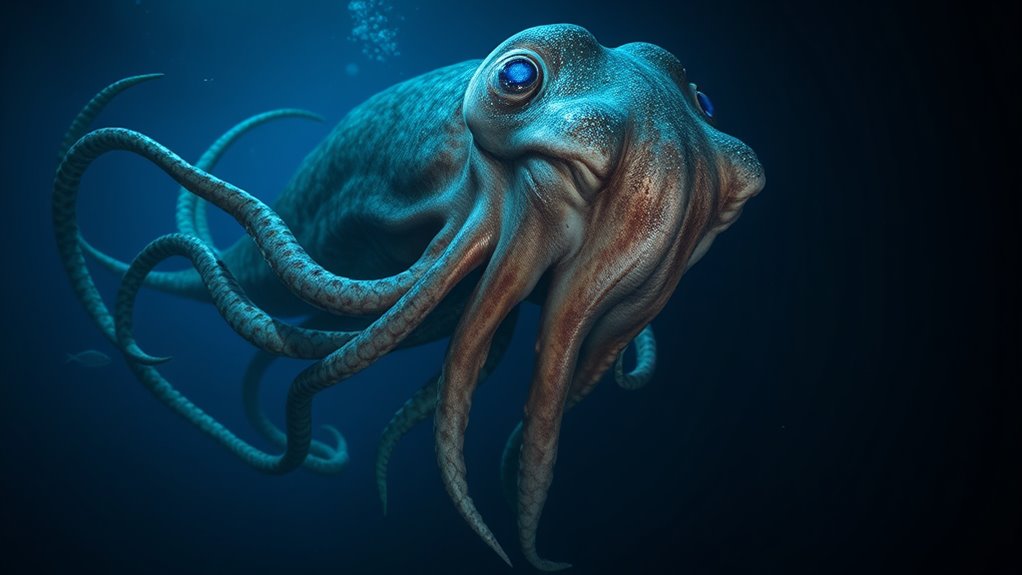
Have you ever wondered how the legendary kraken evolved into the giant squid we comprehend today? The mythological origins of the kraken stretch back centuries, rooted in sailors’ tales of monstrous sea creatures capable of sinking entire ships. These stories, often exaggerated by fear and imagination, painted a picture of a colossal beast lurking in the dark depths of the ocean. Over time, these myths gave rise to the idea of a massive, tentacled monster that inspired awe and terror among seafarers. But beneath the myth, real creatures like the giant squid have evolved remarkable adaptations that allow them to survive in the deep sea’s extreme conditions. These deep sea adaptations include bioluminescence, which helps them communicate, hunt, and avoid predators in the pitch-black environment. Their large eyes are incredibly sensitive to faint light, enabling them to spot prey and threats from great distances. Additionally, their long tentacles are equipped with powerful suckers and hooks, perfect for capturing elusive prey in the deep. Their soft, flexible bodies, combined with a lack of rigid bones, allow them to squeeze into tight spaces and evade predators. These physical features are a direct result of evolution driven by the harsh realities of their habitat, not myth. The giant squid’s ability to dive to depths of over 2,000 feet and withstand crushing pressures is a proof of its specialized deep-sea adaptations. It’s these biological traits that have helped transform the once-feared myth into a real, scientifically studied creature. Remarkably, the giant squid’s elusive nature has kept it shrouded in mystery for centuries, fueling myths and legends about the kraken. Modern marine biology has begun to unravel some of these mysteries, revealing that what was once considered a myth is a highly specialized animal finely tuned for survival in one of Earth’s most extreme environments. So, while the mythological origins of the kraken may have exaggerated its size and ferocity, the real giant squid embodies many of those legendary qualities—just in a way that’s rooted in biological reality. Its adaptations showcase how evolution can turn fearsome legends into fascinating, scientifically verifiable creatures. The shift from myth to science highlights the incredible diversity of life in the deep sea and reminds us that evolutionary processes often produce extraordinary adaptations that surpass imagination.
Frequently Asked Questions
Are There Any Recent Discoveries of Giant Squids Alive?
Yes, recent discoveries of giant squids alive have been made. Using deep sea sonar, scientists have detected large creatures in the ocean’s depths, fueling cryptid sightings and confirming their existence beyond myths. You might be surprised to learn that these elusive creatures are now considered real, thanks to advanced technology capturing their movements. These findings help bridge the gap between legend and marine biology, revealing that giant squids do live in the deep sea.
How Do Giant Squids Communicate Underwater?
You might not realize it, but giant squids probably communicate through bioluminescent signaling and acoustic communication. Studies suggest that their bioluminescent displays help them attract mates or ward off predators, while they may produce sounds to interact with others. Given their deep-sea habitat, these methods are essential for survival, with some evidence indicating that these elusive creatures have sophisticated ways to “talk” underwater, even if we’re just beginning to understand them.
What Is the Lifespan of a Giant Squid?
You might wonder about a giant squid’s lifespan, which typically lasts around 3 to 5 years. During this time, it develops unique deep sea adaptations like changes in squid pigmentation to blend into its environment. These adaptations help it survive the harsh conditions of the deep ocean. Despite their short lives, giant squids grow rapidly, reaching impressive sizes that continue to fascinate scientists and marine enthusiasts alike.
Have Any Giant Squids Been Kept in Captivity?
No giant squids have been kept in captivity for long-term study. Despite numerous historical sightings, attempts to keep them alive in captivity have failed, with the longest holding a giant squid for only a few days. This challenges scientists, as these elusive creatures are incredibly delicate and difficult to study closely. The elusive nature of giant squids keeps their secrets hidden, making captive observation nearly impossible.
What Are the Main Differences Between Myths and Scientific Facts?
You see, myth vs. reality often blurs, but scientific evidence clarifies the differences. Myths are based on stories, fears, or misunderstandings, while scientific facts rely on rigorous research and observation. For example, myths about giant squids being enormous monsters aren’t supported by scientific evidence, which shows they’re real creatures with specific biological traits. Understanding this helps you distinguish between legends and what’s genuinely backed by science.
Conclusion
As you uncover the truth behind the legend, remember that myths often hide a kernel of reality. The giant squid, once a creature of nightmares, reveals nature’s wonder and mystery. Like the ocean’s depths, some stories remain elusive, reminding you that curiosity is the key to understanding our world. So, keep exploring—because sometimes, the greatest truths are hidden beneath the surface, waiting for you to plunge in and discover them.