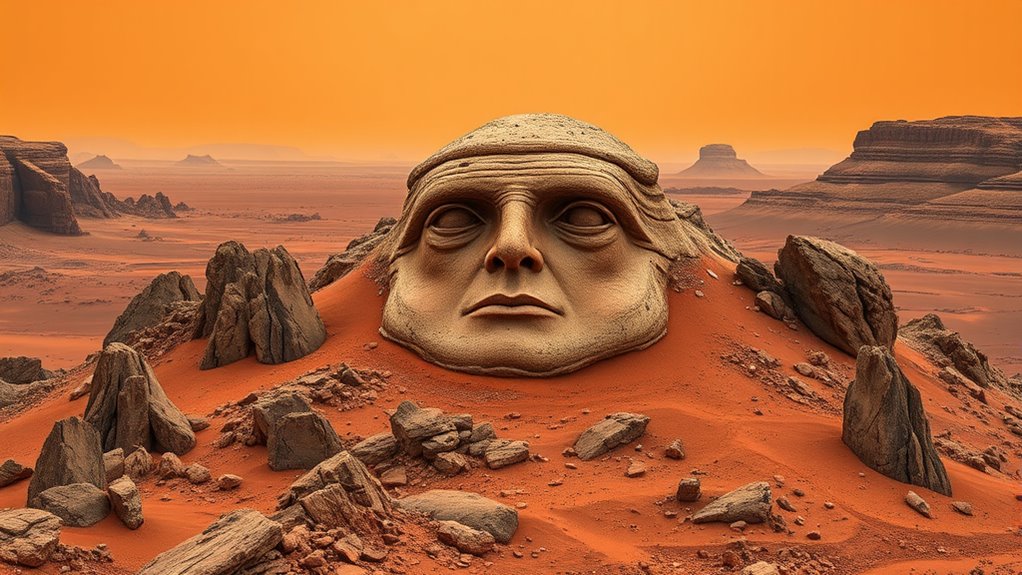

The “Mars Faces” show how natural processes and human perception, especially pareidolia, create the illusion of artificial structures on planetary surfaces. Erosion, shadows, and volcanic activity sculpt the terrain into shapes that can resemble faces or figures. Our brain’s tendency to recognize familiar patterns makes us see these forms even when they’re just natural formations. If you want to uncover what truly lies behind these intriguing shapes, there’s more to explore.
Key Takeaways
- The “Mars Faces” are natural geological formations shaped by erosion, shadows, and volcanic activity, not artificial structures.
- Pareidolia causes humans to perceive familiar faces or shapes in random patterns on planetary surfaces.
- Light and shadow play enhance the appearance of facial features on Mars, contributing to visual illusions.
- Human perception and psychological tendencies can lead to misinterpretations of natural formations as artificial constructs.
- Scientific analysis confirms these features are natural, illustrating how natural processes can mimic familiar patterns.
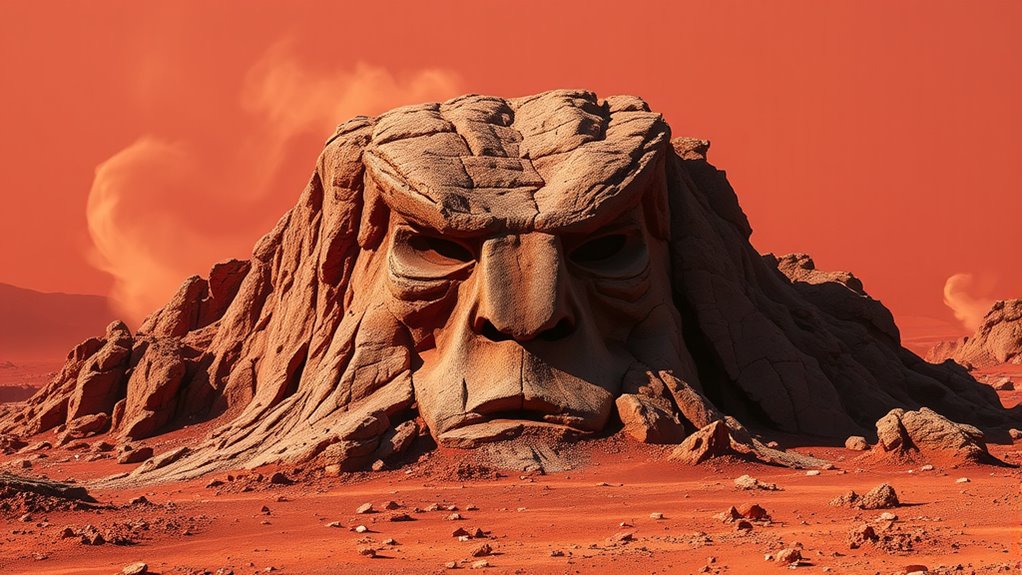
Have you ever wondered if the mysterious formations on Mars are natural or something more intriguing? When you look at the landscape of the Red Planet, you might notice what appear to be facial structures or humanoid shapes. These are classic examples of geological formations that catch the human eye because our brains are wired to recognize familiar patterns, a phenomenon called pareidolia. The famous “Mars Faces” in the Cydonia region exemplify this tendency: jagged cliffs, mesas, and shadows combine to resemble a face, sparking curiosity and speculation. But are these formations truly what they seem, or are they just the result of natural geological processes? Often, what looks like a face is simply the way erosion, wind, and volcanic activity shape the terrain over millions of years. The play of light and shadow can enhance certain features, making them appear more detailed or expressive than they actually are.
As you explore more deeply, it’s important to understand how these geological formations influence our perception. The psychological effects of pareidolia can be powerful, especially when it comes to distant, unfamiliar landscapes like Mars. Your mind seeks familiar patterns for comfort or understanding, which can lead you to see faces, animals, or even structures where none exist. This tendency can ignite imagination but also fuels misconceptions about extraterrestrial life or artificial constructs. While some might interpret these formations as evidence of ancient civilizations or intelligent design, scientific analysis consistently shows that natural processes produce these shapes. Wind-blown dust, layered sediments, and volcanic activity naturally carve the surface into features that, at a glance, resemble recognizable forms. Recognizing geological formations helps you understand the natural origins of these features beyond pareidolia illusions.
This interplay between geology and psychology shapes how we view planetary surfaces. It’s easy to get captivated by what appears to be a “face,” but understanding the underlying geological formations helps you stay grounded in scientific reality. These formations are fascinating because they demonstrate how natural forces sculpt planetary terrains to sometimes mimic familiar images. Recognizing the psychological effects at play reminds you that your perceptions are influenced by your brain’s pattern recognition, which is both a remarkable trait and a potential source of illusion. In the end, whether or not these formations are truly faces, they serve as a reminder of how human perception colors our interpretation of the universe. The Red Planet’s landscapes continue to inspire wonder, inviting you to explore their true nature beyond the illusions of pareidolia.
Top picks for "mars pareidolia planetary"
Open Amazon search results for this keyword.
As an affiliate, we earn on qualifying purchases.
Frequently Asked Questions
What Other Planets Have Similar Pareidolia Phenomena?
You’ll find similar planetary illusions on the Moon, where surface anomalies resemble faces and figures, sparking curiosity and theories. On Venus, radar images reveal formations that look like structures or faces, fueling pareidolia. Even on planets like Mercury and some moons, surface anomalies create visual illusions, causing us to see familiar shapes. These instances highlight how our minds interpret planetary surface features into recognizable forms through pareidolia.
How Do Image Processing Techniques Influence Pareidolia Perception?
Image processing techniques act like a magician’s hat, making hidden images appear out of thin air. When you use image enhancement or false color, you reshape how your brain perceives shapes and shadows, often amplifying pareidolia. These methods highlight features that might otherwise go unnoticed, tricking your eyes into seeing familiar objects or faces where none exist. So, your perception is heavily influenced by how the images are processed.
Are There Ongoing Missions Studying Planetary Surface Features Related to Pareidolia?
Yes, ongoing missions use robotic imaging and data analysis to study planetary surface features that may evoke pareidolia. You can follow missions like NASA’s Mars Reconnaissance Orbiter, which captures high-resolution images, and ESA’s ExoMars, analyzing surface textures and formations. These efforts help scientists understand natural formations and distinguish them from pareidolia-induced perceptions, providing insights into planetary geology and the human tendency to see familiar shapes.
Can Pareidolia Affect Scientific Interpretations of Planetary Geology?
Yes, pareidolia can influence your scientific interpretations of planetary geology. Visual bias, driven by familiar patterns like faces or figures, may lead you to see structures that aren’t scientifically significant. Confirmation influence can reinforce these false perceptions, causing you to overinterpret features based on personal expectations rather than data. Staying objective and relying on rigorous analysis helps you minimize these biases, ensuring more accurate understanding of planetary surfaces.
What Psychological Factors Contribute to Pareidolia Recognition on Mars?
You’re influenced by psychological factors like visual pattern recognition and cognitive bias when recognizing pareidolia on Mars. Your brain seeks familiar shapes, especially faces, due to innate tendencies, leading you to see patterns that aren’t really there. This cognitive bias causes you to interpret random geological formations as meaningful images, making it challenging to distinguish between genuine features and illusions created by your mind’s tendency to find familiar shapes in ambiguous visuals.
Conclusion
As you look at these Martian formations, it’s easy to see why pareidolia captivates us. These faces, like echoes of ancient stories, spark your imagination much like a mirror reflecting hidden shapes. While science seeks explanations, your mind weaves patterns from the randomness, turning rocky outcrops into faces of history. Ultimately, these Martian faces remind you how our perception can turn the ordinary into the extraordinary, much like a painter transforming blank space into a masterpiece.