The Almas, often called the Mongolian Wild Man, is a legendary creature that embodies Mongolia’s wilderness and cultural spirit. Described as shy and elusive, it’s believed to live in remote mountain areas and avoid human contact. Many stories and sightings hint at a creature that could be a remnant of ancient ancestors or primitive primates, fueling ongoing curiosity. If you continue exploring, you’ll uncover fascinating details about its legends, scientific theories, and significance in Mongolian culture.
Key Takeaways
- The Almas is a legendary elusive creature in Mongolian folklore, often called the Mongolian Wild Man.
- It symbolizes Mongolia’s wilderness and cultural respect for nature’s mysteries.
- Sightings and footprints suggest it may be a primitive hominid or ancient human ancestor.
- Modern cryptozoology and scientific efforts continue to explore its mysterious origins.
- The Almas embodies Mongolia’s nomadic heritage and the enduring fascination with the unknown.
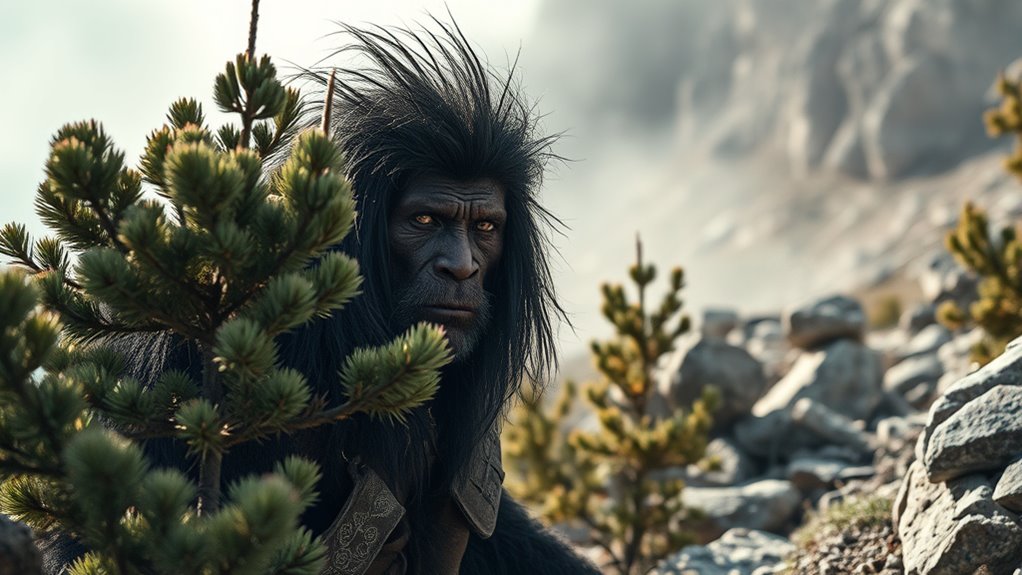
Have you ever heard of the Almas, the rare gemstone prized for its mesmerizing beauty? While most people associate the term with a precious stone, in Mongolia, Almas also refers to a mysterious creature often called the Mongolian Wild Man. This dual meaning adds an intriguing layer to its story. The Almas creature has fascinated explorers and locals alike for centuries, sparking countless legends and debates. Its evolutionary origins remain a mystery, but many believe it could be a remnant of ancient human ancestors or a surviving primitive primate. Some scientists suggest that sightings and footprints point to a creature that defies easy classification, possibly an offshoot of early hominids that adapted to the rugged Mongolian landscape. The story of the Almas is deeply woven into Mongolia’s cultural fabric, where it holds significant cultural importance. The creature symbolizes the wilderness’s mystique and the enduring human fascination with the unknown. Many local legends portray the Almas as a shy, elusive being that lives in remote mountain regions, avoiding human contact. These stories are passed down through generations, reinforcing the creature’s place in Mongolian folklore. The cultural significance of the Almas extends beyond myth; it reflects a respect for nature’s mysteries and the wilderness’s power. For Mongolians, the Almas embodies the spirit of the untamed, a symbol of the rugged independence that defines their nomadic heritage. This creature’s reputation has also attracted explorers, cryptozoologists, and adventurers, all eager to uncover its true nature. Despite numerous sightings and claims, scientific verification remains elusive, fueling ongoing speculation. Some believe that the Almas could be an undiscovered primate species, others see it as a cultural artifact, a myth that has persisted over centuries. Regardless of its true nature, the Almas continues to stir imagination and curiosity. Its story embodies a blend of evolutionary speculation and cultural symbolism. The creature’s elusive nature ensures it remains a fascinating enigma, inspiring stories, research, and a deep sense of wonder. Interestingly, modern scientific methods are increasingly being employed in the search for evidence of such mysterious creatures. Whether as a biological mystery or a cultural icon, the Almas represents humanity’s enduring desire to explore the unknown and understand the ancient ties that bind us to the wilderness. Its legend persists as a tribute to Mongolia’s rich heritage and the universal allure of mysteries that lie just beyond our grasp.
Frequently Asked Questions
Are There Recent Sightings of the Almas?
Recent sightings of the Almas continue to fuel Siberian folklore and cryptid sightings. You might hear stories from locals claiming they’ve seen this elusive creature in remote mountain regions. These reports often describe a hairy, human-like figure, sparking curiosity and skepticism alike. While concrete evidence remains elusive, the ongoing sightings keep the legend alive, reminding you of the mysterious creatures lurking in Siberia’s wilderness, blending myth and reality.
What Habitats Does the Almas Prefer?
You’d think the almas prefers cozy caves or lush forests, but no, it’s a master of environmental adaptations. This elusive creature favors rugged mountainous habitats and remote valleys, where it’s hard for humans to snoop. Its habitat preferences keep it hidden, blending perfectly with the terrain. So, if you’re hunting for the almas, look where nature’s toughest spots meet the wildest environments—nature’s own secret hideouts.
How Do Researchers Differentiate the Almas From Bears?
You can differentiate the Almas from bears by examining biological traits like height, limb proportions, and hair density, which are distinct. Researchers also use tracking methods such as GPS collars and camera traps to observe movement patterns and behaviors. These tools help confirm whether a creature is an Almas or a bear, as the biological traits combined with tracking data provide reliable identification.
Are There Any Cultural Stories Linked to the Almas?
You’ll find that many cultural stories attribute mythical origins to the almas, often viewing them as mysterious guardians of nature. These tales hold deep cultural significance, symbolizing the wild, untamed spirit of the Mongolian landscape. Locals believe the almas embody ancient wisdom and serve as spiritual protectors. Their stories blend reverence and awe, reinforcing the belief that these elusive beings are woven into the very fabric of Mongolian cultural heritage.
What Evidence Supports the Existence of the Almas?
Ancient legends suggest the almas might exist, but modern investigations lack concrete evidence. You’ll find anecdotal reports from locals describing sightings and footprints, yet no scientific proof confirms the wild man’s existence. While these stories fuel curiosity and cultural significance, they remain unverified through rigorous research. So, even with persistent folklore and occasional claims, the alma’s existence stays unproven in the domain of scientific evidence.
Conclusion
So, you’ve now met the Almas, Mongolia’s elusive wild man. You’ve heard the stories, seen the evidence, and maybe even wondered if one day you might spot this mysterious creature yourself. Ironically, after all the searching and speculation, it seems the Almas prefers staying hidden—perhaps because it knows that in the end, the greatest mystery is whether it really exists at all. Guess some secrets are better left in the wild.