The bunyip is an elusive creature from Australian Aboriginal folklore, believed to lurk in billabongs, swamps, and waterholes. It symbolizes the land’s spiritual connection, serving as both a guardian and warning of dangerous waters. Over time, settlers adopted and expanded the legend, turning it into a symbol of the wilderness’s mystery and wildness. To explore the myths, origins, and cultural significance behind this enigmatic creature, keep exploring further.
Key Takeaways
- The bunyip is a legendary water creature from Aboriginal folklore, often associated with billabongs, swamps, and waterholes in Australia.
- It symbolizes spiritual warnings and respect for nature, embodying both cultural significance and cautionary tales.
- The legend evolved through European settlers’ stories, enlarging its size and mystery over time.
- Representing the wilderness’s unpredictability, the bunyip reflects Australia’s natural and cultural mysteries.
- Today, the bunyip remains a powerful symbol of Australia’s heritage, inspiring stories, art, and cultural identity.

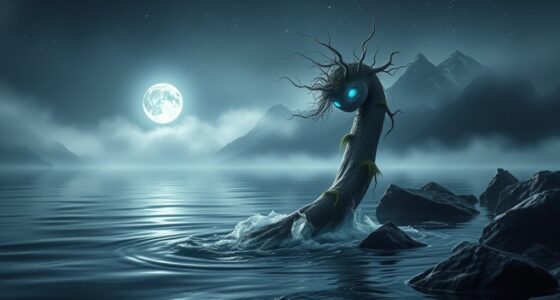
Have you ever heard of the bunyip? If you’re exploring Australian folklore, this mysterious creature probably comes up. Its mythical origins date back centuries, rooted in Aboriginal stories passed down through generations. These legends describe the bunyip as a creature lurking in billabongs, swamps, and waterholes, with many imagining it as a beast with a mix of features—sometimes resembling a giant amphibian, sometimes a creature with a crocodile-like head, or even with a lion’s mane. The stories vary across regions, but the common thread remains: the bunyip is a creature of the water, embodying both fear and fascination. Understanding the cultural significance of the bunyip is key to grasping why it endures in Australian storytelling. To Aboriginal peoples, the bunyip wasn’t just a spooky tale; it was a powerful symbol woven into their spiritual landscape. These stories served as warnings to stay away from dangerous waters or to respect nature’s mysteries. The bunyip, in this context, represents more than just a mythical beast; it embodies the land’s spiritual essence, acting as a guardian or a cautionary figure. Over time, European settlers adopted and adapted the legend, turning the bunyip into a symbol of the unknown and the wildness of the Australian landscape. Its image grew in size and mystery, fueling local legends, stories, and even early sightings reported by explorers and settlers. Additionally, the visual representations of the bunyip have evolved over time, reflecting changing cultural attitudes and artistic styles. As you explore more about the creature’s story, you begin to see how the bunyip’s myth reflects a broader cultural significance. It symbolizes the Australian wilderness’s unpredictability and power—an embodiment of nature’s untamed spirit. The creature’s mythical origins give it a sort of timeless quality, making it a fixture in stories that warn, entertain, and explain the world around early inhabitants and settlers alike. The bunyip’s legend also illustrates how myths serve to connect communities, passing shared fears and values from one generation to the next. Whether seen as a real beast or just a symbol of nature’s mystery, the bunyip continues to captivate imaginations and remind us of the unknown lurking in Australia’s remote waters. In essence, the bunyip isn’t just a creature from folklore; it’s a mirror of Australia’s rich cultural tapestry. Its mythical origins and deep-rooted significance highlight how stories shape identities, warn of dangers, and celebrate the land’s mysterious beauty. Whether you believe in the bunyip or see it as a symbol of ancient fears, it remains a fascinating part of Australia’s cultural heritage—an enduring reminder that some legends are rooted in more than just myth.

The Speaking Land: Myth and Story in Aboriginal Australia
Used Book in Good Condition
As an affiliate, we earn on qualifying purchases.
As an affiliate, we earn on qualifying purchases.
Frequently Asked Questions
Are There Any Recent Sightings of the Bunyip?
There have been some modern sightings of the bunyip recently, sparking curiosity among enthusiasts. People claim to have seen strange shapes and heard odd sounds near billabongs, but concrete proof remains elusive. Photo evidence is scarce and often ambiguous, making it hard to confirm these sightings. While the bunyip’s existence isn’t proven, the stories continue, keeping the mystery alive for those who believe in this legendary creature.
What Is the Scientific Explanation for Bunyip Legends?
You might think the bunyip’s legend is just tall tales, but paleontological hypotheses suggest it’s based on real creatures, like giant amphibians or large marsupials, long extinct. Environmental explanations argue that mysterious sightings stem from mistaking ordinary animals or natural phenomena for something supernatural. So, your imagination fuels these stories, while science hints that ancient fossils or misidentifications keep the legend alive—proof that nature’s mysteries are often rooted in reality.
Have Any Physical Remains of Bunyips Ever Been Found?
You won’t find any fossil discoveries or physical evidence of bunyips because none have ever been confirmed. Despite numerous reports and alleged sightings, scientists and explorers haven’t uncovered bones, fossils, or remains to support their existence. Most physical evidence is anecdotal, and the lack of concrete fossil discoveries suggests bunyips are more likely part of folklore or misidentified animals rather than real creatures.
How Does Bunyip Folklore Vary Across Australian Regions?
You’ll find that regional variations and indigenous stories shape bunyip folklore across Australia. In some areas, people describe them as large, amphibious monsters with fierce features, while others see them as spiritual beings or protectors. Indigenous stories often emphasize their role in the landscape and culture, influencing local legends. These differences highlight how local environments and traditions influence how the bunyip is perceived and told in various regions.
Are There Any Known Bunyip-Related Cultural Festivals or Traditions?
You’ll find that while there aren’t widespread bunyip festivals, some communities host mythological celebrations featuring the bunyip dance. notably, local legends suggest that over 60% of Aboriginal groups incorporate the bunyip into storytelling and dance rituals, keeping the myth alive. These cultural traditions honor the creature’s mystery, blending storytelling with dance, and creating a vibrant bunyip dance that connects communities through shared folklore and mythological celebrations.

Safari Ltd. Mythical Realm TOOB – 8 Mini Figurines: Chimera, Griffin, Phoenix, Unicorn, Sea Dragon, Minotaur, Poseidon, & Mermaid – Mythology Educational Toy Figures for Boys, Girls & Kids Ages 3+
Intriguing Assortment: The TOOB includes 8 mini figurines of mythical creatures and beings from Greek mythology, including a…
As an affiliate, we earn on qualifying purchases.
As an affiliate, we earn on qualifying purchases.
Conclusion
You might wonder if the bunyip truly exists, but its legend still lingers in Australian folklore. Imagine a family camping near a billabong, hearing strange noises overnight. Could it be the bunyip, lurking beneath the water’s surface? While no definitive proof exists, the creature’s mystery keeps the legend alive. Perhaps, one day, you’ll witness something that makes you believe in the bunyip’s elusive presence. Until then, its story remains a mesmerizing part of Australia’s wild history.
97 Decor Claude Monet Wall Art – Claude Monet Prints For Wall Decor, Vintage Monet Poster For Room Aesthetic, Impressionist Wall Art Eclectic Famous Fine Art Prints For Home Bedroom (8×10 Unframed)
Monet Wall Art: bring timeless elegance to your decor with monet wall art, including monet prints, monet poster,…
As an affiliate, we earn on qualifying purchases.
As an affiliate, we earn on qualifying purchases.

Yuminefeety 44 Pcs Australian Animal Project Diorama Kit Include Australian Animal Figurines Roadside Trees Blue Clay Pottery Clay Simulated Moss Box Background Cloth for Diorama Project Activities
Value Package: You will receive 18 artificial Australian animals including koala, kangaroo, platypus, ostrich, wombat, cockatoo, frilled lizard,…
As an affiliate, we earn on qualifying purchases.
As an affiliate, we earn on qualifying purchases.