
TL;DR

Prime made for students and young adults
- Fast, free delivery for dorm and study essentials
- Prime Video and Amazon Music included
- Member-only deals
IdeaClyst is a local-first platform that acts as a war room for your ideas. It combines AI-driven critique, structured collaboration, and research grounding to boost confidence and reduce market failure risk. Think of it as your own personal think tank on your laptop.
Imagine sitting at your desk, staring at three different startup ideas, each promising but all risky. It’s the classic founder’s dilemma: which one deserves your next six months?
Now, picture a tool that acts like a war room—an environment where your ideas are rigorously tested, debated, and refined, all on your own machine. That’s what IdeaClyst offers. It’s not just another brainstorming app; it’s a structured, disagreement-driven AI council that helps you build conviction before you spend a single dollar or hour.
In this article, I’ll walk you through what makes IdeaClyst a game-changer—why it’s the war room every founder needs, and how it can save you from the costly mistakes most startups make.
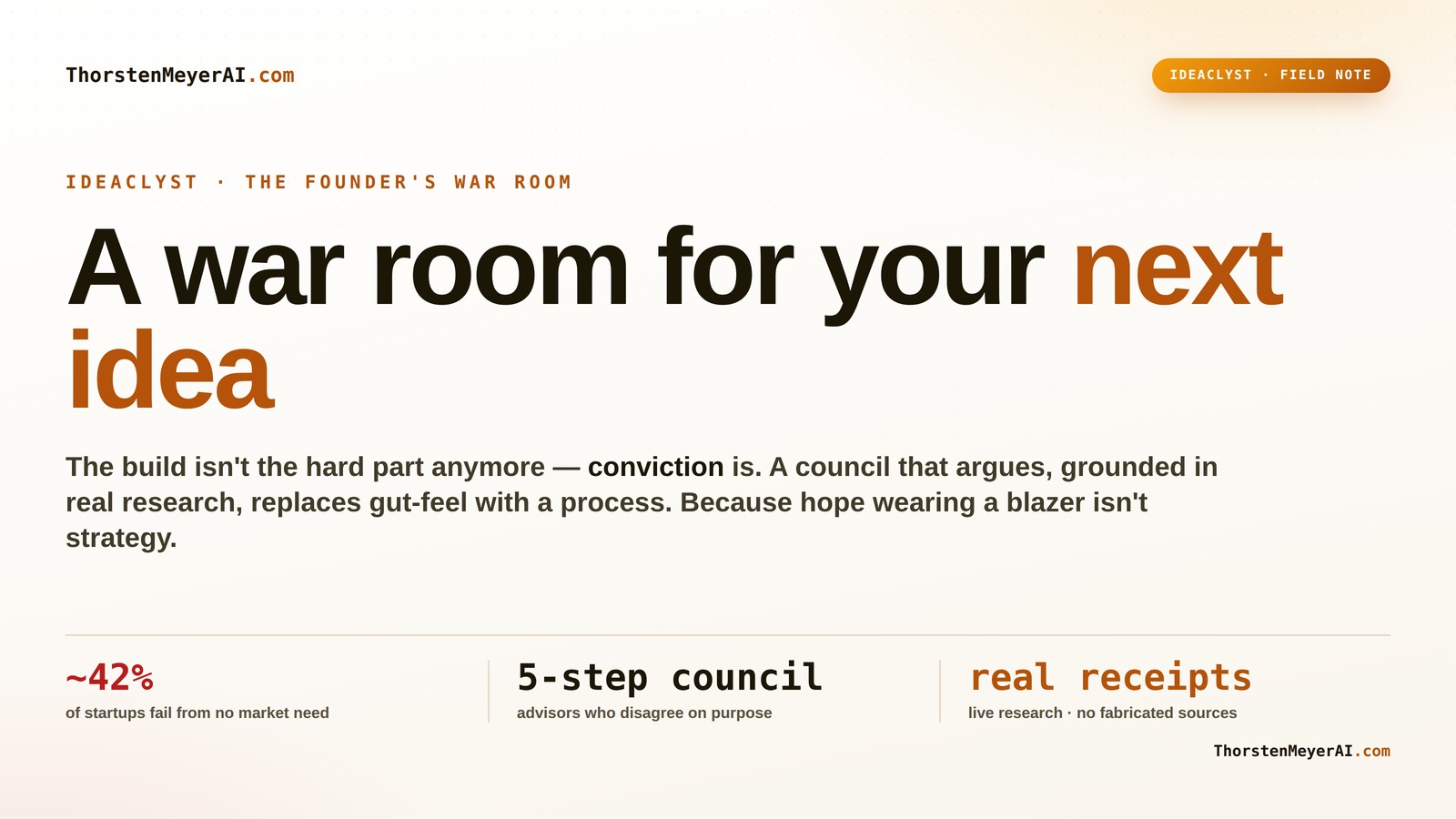
A war room for your next idea
The build isn’t the hard part anymore — conviction is. Knowing which idea deserves the next six months, and being able to defend it. Most founders answer with gut feel and optimistic math. That’s hope wearing a blazer. IdeaClyst replaces it with a process.
The most expensive decision is what to build
The single most valuable thing a tool can do is talk you out of the wrong six months. The numbers make the case better than any pitch.
Three tools in one — on your own machine
Strip away the framing and IdeaClyst is three things at once, all running locally with nothing leaving your laptop.
An AI council
Pressure-tests an idea you bring it — advisors who argue on purpose.
A discovery engine
Finds ideas you didn’t know to look for by hunting real demand signals.
A founder’s workspace
Carries winners from “interesting” all the way to “ready to build.”
Advisors who disagree on purpose
Not one confident, agreeable answer — a structured five-step deliberation where models play different roles and turn on their own work. The disagreement is the feature.
The five-step deliberation
A council that leads with the bad news surfaces the objections you’d otherwise find the expensive way, on month five.
Product strategy
Who’s it for, what’s the wedge, why now, what’s the business model.
Technical architecture
What would it actually take to build — and where’s the risk.
Critique pass
The council turns on its own work. Where’s the hand-waving? What kills this?
Second, independent critique
A different voice, a different angle — so blind spots don’t survive.
Final synthesis
Everything into one coherent founder packet: strategy, architecture, validation, plan.
When IdeaClyst cites a source, it actually fetched it
The hard departure from “ask an AI what it thinks of my startup.” It runs in a strict, real-data-only mode — if it can’t gather genuine evidence, it says so plainly rather than inventing a plausible paragraph.
Confidence with receipts
No fabricated statistics, no imaginary competitors, no made-up citations. The packet survives a skeptical co-founder or a sharp investor because the reasoning has receipts.
Market research first
Scouts the landscape before the council reasons about anything.
Competitor read
Real positioning, pricing signals, feature claims — differentiation vs. reality.
Validation with links
Not “talk to customers” — concrete signals & sources you can click.
From the blank page to build-ready
Evaluation is half the problem; the blank page is the other half. And a plan is worthless if it dies in a tab you never reopen.
Bring a space, not an idea
“AI for accountants,” “tools for indie game studios” — plus your goal and real capacity. It hunts demand signals across HN, Reddit, Product Hunt, GitHub, pricing pages.
- An honest market read — leads with the bad news when a space is hard
- An opportunity map — high pain, thin competition
- Ranked candidates — wedge, who pays, effort, risk, confidence
- each with KILL CRITERIA — when to walk away
A home and a forward path
Every promising idea gets carried forward, with every artifact in plain files on your disk.
- Validation tooling — sprint board, interview list, evidence browser
- Founder profile — a personal-fit lens; same discovery, different advice
- Build workspaces — funnel, personas, landing draft, version history
- “Build this idea” → a PRD + task queue, ready for a coding agent
Key Takeaways
- IdeaClyst acts like a personal war room, structured to rigorously test and refine your ideas before costly development.
- Its disagreement-driven AI council uncovers flaws faster, saving time and money—cutting validation from months to hours.
- Grounding critiques in live web data prevents false confidence and ensures your validation is based on real, current facts.
- Everything stays on your local machine, giving you full control, privacy, and ownership of your ideas and validation reports.
- Following a simple step-by-step process makes even fuzzy ideas into solid, defendable plans in just a few hours.
As an affiliate, we earn on qualifying purchases.
Why Your Next Idea Needs a War Room — Fast and Focused
Picking your next project is like walking a tightrope. The stakes? Millions of dollars, months of work, your reputation. A dedicated war room turns that tightrope into a controlled environment.
For example, a founder I know used IdeaClyst to evaluate a SaaS product idea in just a few hours. Normally, that process drags on for weeks, with endless debates and gut calls. This platform compresses months of research into a single afternoon, giving crystal-clear insights.
According to CB Insights, 42% of startup failures stem from building something no one needs. The cost of that mistake? Over $150,000 for a typical six-month misfire. A war room like IdeaClyst cuts that risk dramatically.
Why does this matter? Because in startup life, time and resources are your most precious assets. A structured environment minimizes the guesswork, accelerates validation, and helps you identify fatal flaws early. It’s about making smarter decisions faster, which can mean the difference between success and failure.
As an affiliate, we earn on qualifying purchases.
What Makes IdeaClyst the Ultimate Virtual War Room?
IdeaClyst isn’t just a fancy brainstorming tool. It’s a local-first, AI-powered council that acts like a diverse set of advisors arguing over your idea. Imagine a team of experts—product strategist, technical architect, market critic—all disagreeing on your behalf, to find flaws you might miss.
Here’s what it does:
- Structured Debate: It stages five deliberate steps—strategy, architecture, critique, second critique, and synthesis—ensuring no stone is left unturned. This structured process is vital because it forces you to systematically evaluate every aspect of your idea, reducing oversight caused by haphazard thinking. It helps you see connections and conflicts you might overlook in casual brainstorming, leading to more robust validation.
- Disagreement as a Feature: Instead of one cheerleader AI, it’s a panel that challenges your assumptions, exposing weak spots before you build. This intentional disagreement pushes you to defend your ideas and uncover blind spots, which otherwise might only surface after costly development. The tradeoff? It requires more upfront effort, but that effort pays off by preventing expensive pivots later.
- Grounded Research: It pulls real-time data from the web—market size, competitors, trends—so your validation isn’t just gut feeling. This grounding in current data helps you avoid false positives that come from outdated or biased information, ultimately leading to more accurate assessments of market potential and technical feasibility.
- Local and Private: All data stays on your machine, safe from prying eyes. No cloud, no subscriptions, just plain files. This privacy focus means you can iterate freely without worrying about leaks or data breaches, especially important for sensitive or proprietary ideas.
Think of it as an internal courtroom for your ideas, where every argument sharpens your confidence. This environment enables you to explore different perspectives, challenge assumptions, and arrive at a well-defended, validated plan before investing significant resources. Learn more about creating effective innovation environments.
Check out more at IdeaClyst.
AI research assistant for startups
As an affiliate, we earn on qualifying purchases.
As an affiliate, we earn on qualifying purchases.
How the AI Council Finds Flaws You Miss — and Why That Matters
The biggest risk in startup life? Blind spots. Your gut and a single AI cheerleader won’t cut it. IdeaClyst’s secret sauce is its council—five AI models, each with a different role, that argue and critique your idea from multiple angles.
For example, one model questions your target market’s size, another challenges your technical feasibility. Their disagreements aren’t noise—they’re signals. When they finally synthesize their critiques into a founder’s packet, you get a clear, evidence-backed plan. Discover how structured debate can improve your decision-making.
This process cuts down the typical six-month validation cycle to a few hours, saving thousands and preventing costly pivots later. The implication? You gain confidence faster, make better-informed decisions, and avoid the trap of confirmation bias that often leads founders astray. The tradeoff is that you need to interpret conflicting opinions and decide which critiques to act on, but this is precisely where deeper insight and learning happen. It’s an accelerated, rigorous way to uncover issues that might only surface after multiple costly mistakes.
According to research from Thorsten Meyer AI, structured disagreement accelerates learning and reveals hidden assumptions faster than consensus-building alone.
local AI-powered idea development platform
As an affiliate, we earn on qualifying purchases.
As an affiliate, we earn on qualifying purchases.
Ground Your Ideas in Real Data — Not Just Model Vibes
Many AI tools talk a big game but answer based on memory and pattern-matching, often giving vague or overly optimistic advice. IdeaClyst stands apart by grounding its critique and suggestions with live web research.
For instance, instead of saying “market growing rapidly,” it pulls current data—market size, recent trends, competitor activity—so your validation is based on real facts, not assumptions. This approach ensures your confidence isn’t misplaced by outdated or overly optimistic claims, and it highlights actual market opportunities or threats that could otherwise be overlooked.
This real-time grounding prevents the trap of false confidence—when you hear “great concept” but don’t know if the market is actually large or saturated. It encourages a more nuanced understanding, prompting you to ask better questions and seek more precise data. Learn more about making chemistry accessible and data-driven.et was only half the size they initially thought, saving months of misdirected effort. Because the platform writes everything to your disk as Markdown, you own and can verify every step, fostering transparency and trust in your validation process.
Learn more about how AI can help with real data at IdeaClyst.
A Step-by-Step Guide to Using IdeaClyst as Your War Room
Ready to turn your idea into a battle-tested plan? Here’s how to get started with IdeaClyst:
- Write a rough idea: Capture your concept in a sentence or two.
- Launch the council: Upload your idea and let the AI models convene.
- Review the debate: Read through the structured critiques and disagreements.
- Refine your idea: Incorporate the feedback into a revised plan.
- Generate the final report: Save your founder packet, ready for pitching or development.
Using this process, even a novice founder can turn a fuzzy idea into a solid plan in a few hours. Plus, all notes and critiques are saved locally, so your work stays private and versioned.
Compare IdeaClyst to Other Idea Tools — Who Wins?
| Feature | IdeaClyst | Traditional Brainstorming | Generic AI Tools |
|---|---|---|---|
| Structured debate | Yes, five-step council with disagreements | No, freeform | Sometimes, but often superficial |
| Grounded in real data | Live web research integrated | Mostly opinions or outdated info | Depends on prompts, no live data |
| Local-first & privacy | Yes, everything stored on your machine | No, cloud-based | Mostly cloud |
| Disagreement-driven critique | Yes, multiple models argue | No | Rarely |
| Ownership & control | Own all files | Depends on platform | Usually proprietary |
Compared to traditional brainstorming or generic AI tools, IdeaClyst offers a rigorous, grounded, and private environment designed for real validation, not just idea generation.
Frequently Asked Questions
Is IdeaClyst suitable for small startups or solo founders?
Absolutely. Its local-first design makes it perfect for solo founders and small teams who want powerful validation tools without cloud dependencies or hefty costs. It scales with you.How does IdeaClyst ground its critiques in real data?
It pulls live web research, including current market sizes, trends, and competitor info, directly into your idea assessment—so your validation is based on facts, not guesses.Can I customize the stages or process within IdeaClyst?
Yes. You can tailor the workflow, critique focus, and research parameters to fit your specific innovation process or organizational style.Is my data safe with IdeaClyst?
Since everything runs locally on your machine, your ideas and reports stay private and under your control. No data leaves your device unless you choose to share it.What’s the learning curve for using IdeaClyst effectively?
It’s designed to be intuitive, with step-by-step guidance. Most founders get comfortable within an hour and start turning fuzzy ideas into solid plans quickly.Conclusion
Think of IdeaClyst as your own private war room—an environment where every idea gets challenged, debated, and sharpened before you build. It’s not just about smarter validation; it’s about building conviction and confidence that your next move is right.
For any founder tired of guessing, it’s time to bring the war room home. Your next big idea deserves it—and so do you.
Fall Picks
fall essentials
As an affiliate, we earn on qualifying purchases.