The science behind giant squids reveals incredible adaptations that allow them to thrive in the deep sea’s darkness and crushing pressures. Their flexible, cartilaginous bodies, large eyes, and rapid camouflage help them hunt and avoid predators. Their tentacles are equipped for capturing prey, while their skin can change color quickly. These adaptations have turned legends into scientific fact, offering fascinating insights into extreme environment survival. Exploring further uncovers even more about these mysterious creatures’ remarkable biology.
Key Takeaways
- The giant squid’s large eyes and advanced sensory adaptations enable deep-sea survival and prey detection in darkness.
- Mesonychoteuthis, or colossal squids, possess specialized bodies resistant to extreme high-pressure environments.
- Camouflage, flashing, and tentacle adaptations aid in ambush hunting and predator avoidance in deep-sea habitats.
- Scientific research has transitioned from mythic legends to understanding their biological and morphological complexities.
- Ongoing studies reveal the evolutionary link between mythic giant squids and real species like Mesonychoteuthis.
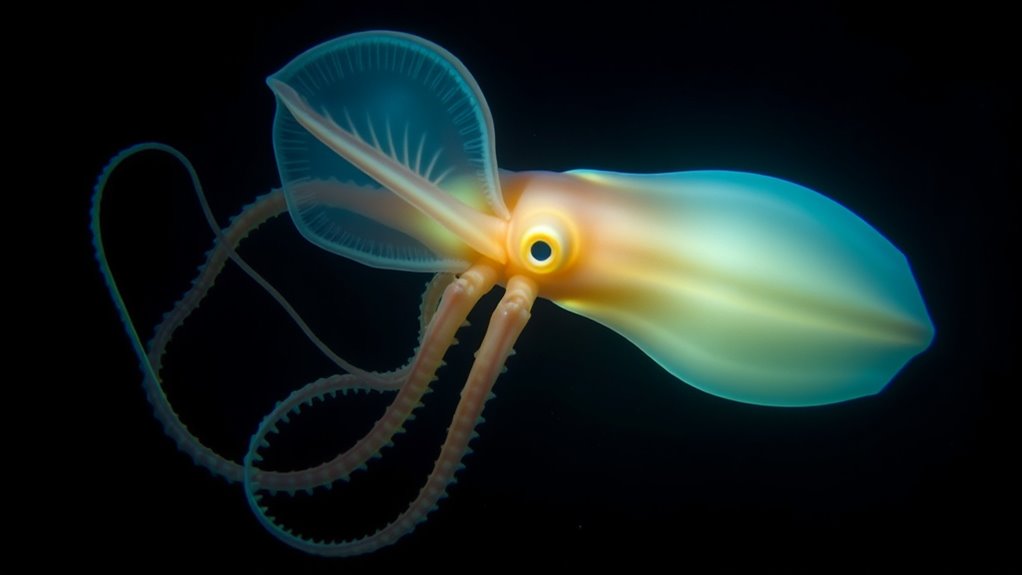
The giant squid, a mysterious and elusive creature of the deep ocean, has long fascinated scientists and explorers alike. Its ability to survive in the crushing depths of the ocean requires unique adaptations that set it apart from many other marine animals. You might be surprised to learn just how specialized these creatures are for life in such extreme environments. Deep sea adaptations help the giant squid endure the intense pressure, cold temperatures, and scarce light that define its habitat. Its body is built to withstand immense pressure, with a flexible, cartilaginous structure that resists crushing forces. Unlike shallower water creatures, it has a reduced or absent swim bladder, preventing it from being crushed under the weight of the water column. These adaptations enable it to roam the dark, deep ocean where few other predators can survive. Additionally, these creatures exhibit translucent skin, which aids in their camouflage by reducing visibility in the deep-sea environment.
Deep sea adaptations enable the giant squid to survive crushing pressures and extreme darkness in the ocean’s depths.
A key aspect of the giant squid’s survival is its ability to employ squid camouflage. In the abyssal depths, where light barely penetrates, blending into the environment becomes a matter of life and death. The squid’s skin contains specialized cells called chromatophores, which allow it to change color rapidly. This ability to camouflage helps it avoid predators and ambush prey alike. When threatened, the giant squid can darken its body to blend into the surrounding darkness, making it nearly invisible in the murky depths. Conversely, it can also flash bright patches to confuse predators or communicate with others of its species. This dynamic camouflage is essential for survival, especially considering the sparse population and limited hunting opportunities in its environment.
Beyond camouflage, the giant squid’s eyes are remarkably adapted to the deep sea. They are among the largest in the animal kingdom, allowing it to detect faint traces of light and movement in the perpetual darkness. These large eyes help locate prey such as fish and smaller squid, even when they’re far away or obscured by the water’s murkiness. Its tentacles, equipped with powerful suckers and hooks, are designed for capturing and holding onto prey in the low-visibility environment. All these features—deep sea adaptations, camouflage, and specialized sensory organs—combine to make the giant squid a master of survival in one of Earth’s most inhospitable habitats.
Understanding these adaptations not only reveals the creature’s incredible biology but also underscores why the giant squid has long been a subject of fascination and myth. As scientists continue to study and uncover its secrets, the distinction between legend and reality becomes clearer, yet the mystique of this deep-sea giant remains profound.
Frequently Asked Questions
How Do Giant Squids Communicate With Each Other Underwater?
You might not realize it, but giant squids communicate underwater through bioluminescent signaling, flashing light patterns to send messages or warn others. They also use ink cloud communication, releasing ink to create a visual barrier or signal danger to nearby squids. These methods help them coordinate, find mates, or defend themselves in the dark depths of the ocean. You can think of their communication as a secret, glowing language in the deep sea.
What Is the Average Lifespan of a Giant Squid?
Imagine the giant squid’s life as a fleeting, shimmering dance beneath the waves; you’ll find it lives around 3 to 5 years. Like other cephalopods, it relies on marine bioluminescence to communicate and camouflages through cephalopod regeneration. In this brief but vibrant existence, each moment is precious as it navigates the deep, mysterious ocean, leaving behind stories written in light and ink.
How Do Giant Squids Hunt Their Prey in the Deep Ocean?
You observe that giant squids hunt using strategic hunting tactics. They rely on bioluminescent signaling to communicate and attract prey in the dark, deep ocean. They use their large eyes to spot targets and employ swift tentacle strikes to grab them. Their hunting strategies include ambushing prey near the ocean floor or chasing it through sudden bursts of speed, making the most of their deep-sea environment.
Are Giant Squids Related to Other Large Cephalopods?
You might think giant squids are isolated, but they’re actually related to other large cephalopods like colossal squids, sharing common ancestors in cephalopod evolution. For example, fossil evidence suggests a link between giant squids and their relatives, highlighting how marine biodiversity has shaped their development. This connection helps us understand their evolutionary history and their role in deep-sea ecosystems, illustrating the fascinating diversity within the cephalopod family.
What Are the Latest Technological Methods Used to Study Giant Squids?
You use advanced deep sea imaging techniques, like remotely operated vehicles and baited cameras, to observe giant squids in their natural habitat without disturbance. Genetic analysis also plays a essential role, helping you understand their evolutionary relationships and diversity. These methods allow you to gather critical data on behavior, anatomy, and genetics, revealing more about these elusive creatures that once only existed in myth.
Conclusion
Now that you understand the science behind the giant squid, it’s clear they’re more than just myths. Imagine you’re deep-sea diving and suddenly spot a massive creature gliding past—it’s a Mesonychoteuthis. This real encounter highlights how much we’re still learning about these elusive giants. As research advances, you’ll see how these creatures reveal secrets of the ocean’s depths, transforming legends into scientific reality—proving that the giant squid is truly a marvel of nature.