
The globster phenomenon involves mysterious, decayed marine masses washing ashore, often confusing those who find them. These large, tangled tissue blobs lack clear bones or fins, making identification challenging. Scientists use DNA analysis to uncover their true origins, which are usually whales, sharks, or other known animals—though some cases remain unresolved. If you’re curious about what these strange sea blobs might be, there’s more to uncover about how science continues to explore these marine mysteries.
Key Takeaways
- Globsters are large, decomposed marine tissue masses washing up on beaches, often confusing due to their irregular shapes and lack of identifiable features.
- They are typically composed of remains from known animals like whales or sharks, identified through DNA analysis, but some remain mysteries.
- The phenomenon fuels myths, legends, and conspiracy theories, highlighting the ocean’s unexplored and mysterious nature.
- Scientific advances in marine forensics help identify many globsters, though some cases remain unresolved due to tissue degradation.
- Globsters emphasize the ocean’s vast unknowns, sparking ongoing curiosity and research into marine life and potential undiscovered species.
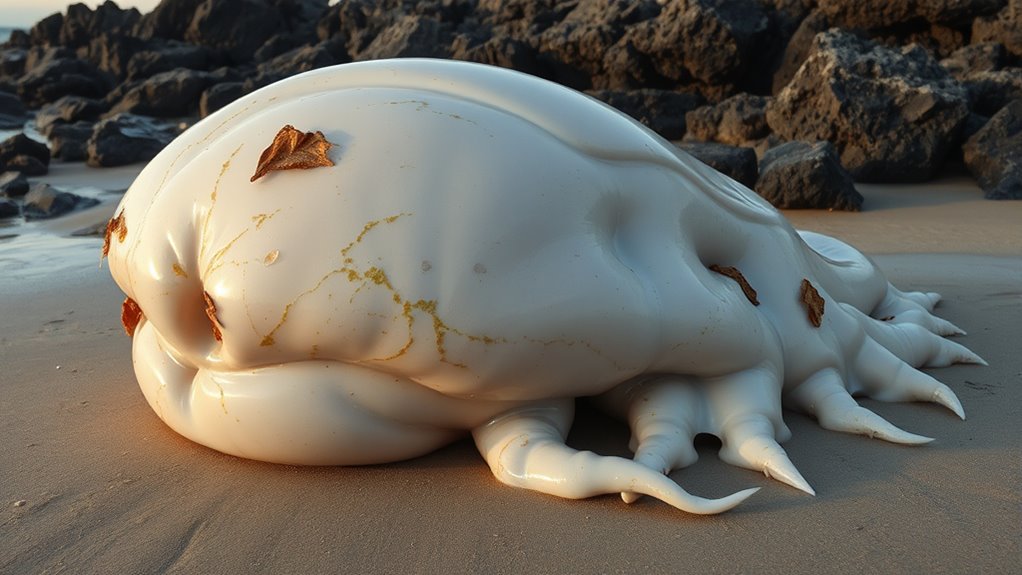
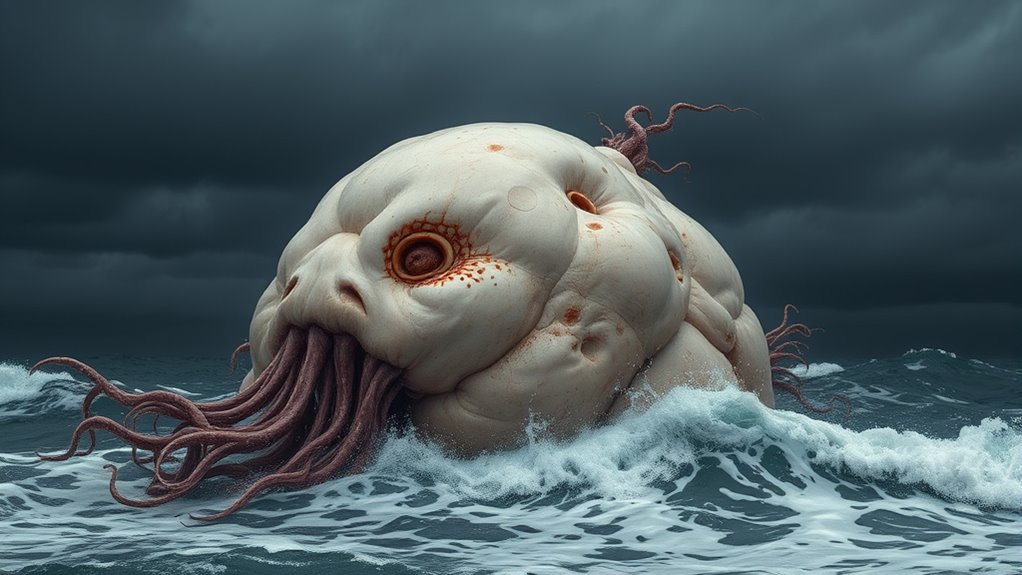
The globster phenomenon refers to large, mysterious masses of decomposed marine animal tissue that wash up on beaches worldwide. These enigmatic blobs often baffle scientists and beachgoers alike, sparking curiosity and speculation about their origins. As you observe these ocean enigmas, it’s clear that they add another layer to the ongoing marine mysteries that continue to puzzle researchers. These decayed remains, sometimes measuring several meters across, appear unexpectedly and defy easy identification. Their irregular shapes, tangled tissues, and lack of any clear bones or fins make it difficult to determine what creature they once belonged to, fueling debates and theories among marine biologists and enthusiasts.
What makes globsters especially intriguing is how quickly they decompose, leaving behind unrecognizable tissue masses that seem to defy conventional understanding of marine life. Sometimes, they are initially mistaken for giant squids or unknown sea monsters, only to be later identified as the remains of whales, sharks, or other known marine animals. However, in many cases, the absence of bones or identifiable features leads to speculation about whether some globsters could be leftover remnants of extinct or mythical creatures. These ocean enigmas often inspire conspiracy theories and legends about sea monsters lurking in the depths, adding to the allure of marine mysteries that continue to elude definitive explanations.
As you explore more deeply into the globster phenomenon, you realize that advances in DNA analysis and marine forensics have helped clarify some cases, revealing the true identities of many globsters. Yet, gaps remain, especially when tissue samples are too degraded for precise testing. These unresolved cases keep the mystery alive, encouraging scientists to investigate new techniques and hypotheses. The fact that globsters tend to appear unpredictably, sometimes after storms or rough seas, suggests a connection to natural processes like decomposition, scavenging, or underwater currents. Still, the question remains: could some globsters be evidence of undiscovered species or rare mutations? Their occasional appearance sparks fascination and concern, reminding us how much of the ocean remains unexplored. Advances in DNA analysis have played a crucial role in identifying numerous globsters, helping differentiate between known marine animals and potentially unknown entities.
In the end, the globster phenomenon exemplifies how marine mysteries continue to challenge our understanding of ocean enigmas. Each new discovery or sighting adds a piece to the puzzle, yet many globsters remain unidentifiable. They serve as a reminder that the ocean holds countless secrets, waiting to be uncovered by curious minds willing to investigate its depths. Whether these blobs are simply decomposed remains or the remnants of something extraordinary, their mystery persists, fueling our fascination with the unknown parts of the sea. You can’t help but wonder what other secrets lie beneath the waves, waiting to be revealed by future marine investigations.
Frequently Asked Questions
What Causes Globsters to Decompose so Rapidly?
You might notice globsters decompose quickly because their tissue decay rates are high, especially in salty, oxygen-rich seawater. The exposure to bacteria and scavengers accelerates decomposition, breaking down tissues rapidly. Environmental factors like temperature, microbial activity, and water currents also influence how fast these blobs break down. So, the combination of biological and environmental elements causes globsters to decompose at a swift pace, making them hard to preserve over time.
Have Any Globsters Been Conclusively Identified?
Most globsters haven’t been conclusively identified, but some have been. Marine taxonomy and biological identification have revealed that certain globsters are actually known animals, like decomposed whales or giant squids. These discoveries help demystify the phenomenon, showing that what once seemed mysterious often has a scientific explanation. By focusing on biological identification, researchers can better understand these enigmatic masses and distinguish them from truly unidentified sea creatures.
Are Globsters Linked to Any Specific Oceanic Regions?
You’ll find globsters mainly in specific oceanic regions, with many linked to deep sea mysteries. These unidentified sea blobs often appear along coastlines where regional patterns of decomposition and currents influence their distribution. While some discoveries are isolated, others suggest a pattern tied to particular oceanic environments. Exploring these regional patterns helps scientists understand the origins of globsters and the broader mysteries lurking beneath the ocean’s surface.
How Do Scientists Differentiate Globsters From Known Marine Animals?
You can differentiate globsters from known marine animals by examining their morphological features and conducting DNA analysis. Scientists compare the physical structure, like shape and texture, to known species, but often these features are distorted or decomposed. DNA analysis helps confirm if the remains belong to an identifiable creature or a new species, providing definitive evidence beyond visual inspection. This combination guarantees accurate identification of unexplained sea blobs.
What Historical Globster Sightings Remain Unexplained?
Imagine a lost chapter of marine folklore where a massive, unidentified blob washed ashore in 1896, baffling all who saw it. Such sightings remain unexplained, fueling ocean mysteries and legends. These historical globsters, like the 1950s “Cadborosaurus” sightings, stir curiosity because scientists can’t match them to known animals. They remind us of the ocean’s secrets, waiting to be uncovered, and keep the lore alive in maritime history.
Conclusion
As you immerse yourself in the mystery of globsters, you realize they’re like ghost ships drifting through our understanding—silent, elusive, and haunting. These enigmatic sea blobs remind us that the ocean still holds secrets, waiting to be uncovered. Each discovery is a piece of the puzzle, a whisper from the deep that sparks curiosity and wonder. Keep exploring, because in the vast ocean of the unknown, every new find is a lighthouse guiding us closer to the truth.