
TL;DR

Prime made for students and young adults
- Fast, free delivery for dorm and study essentials
- Prime Video and Amazon Music included
- Member-only deals
Building an AI workstation was always cheaper, but in 2026, prebuilt systems often match or beat DIY costs thanks to bulk buying and shortages. The choice now hinges on your time, expertise, and support needs.
Imagine a sleek, ready-to-ship AI powerhouse sitting in front of you—no assembly required. That’s the allure of a prebuilt system in 2026. But is it really the smarter choice, or do you still get more bang for your buck building your own?
Today’s landscape is more complex, with options ranging from custom builds to preconfigured systems, which you can explore in detail on haltmal.com. Prices for GPUs, RAM, and SSDs have surged, but so have the options for preconfigured systems with enterprise-grade cooling and warranties. This isn’t just about saving a few bucks; it’s about weighing time, support, and control.
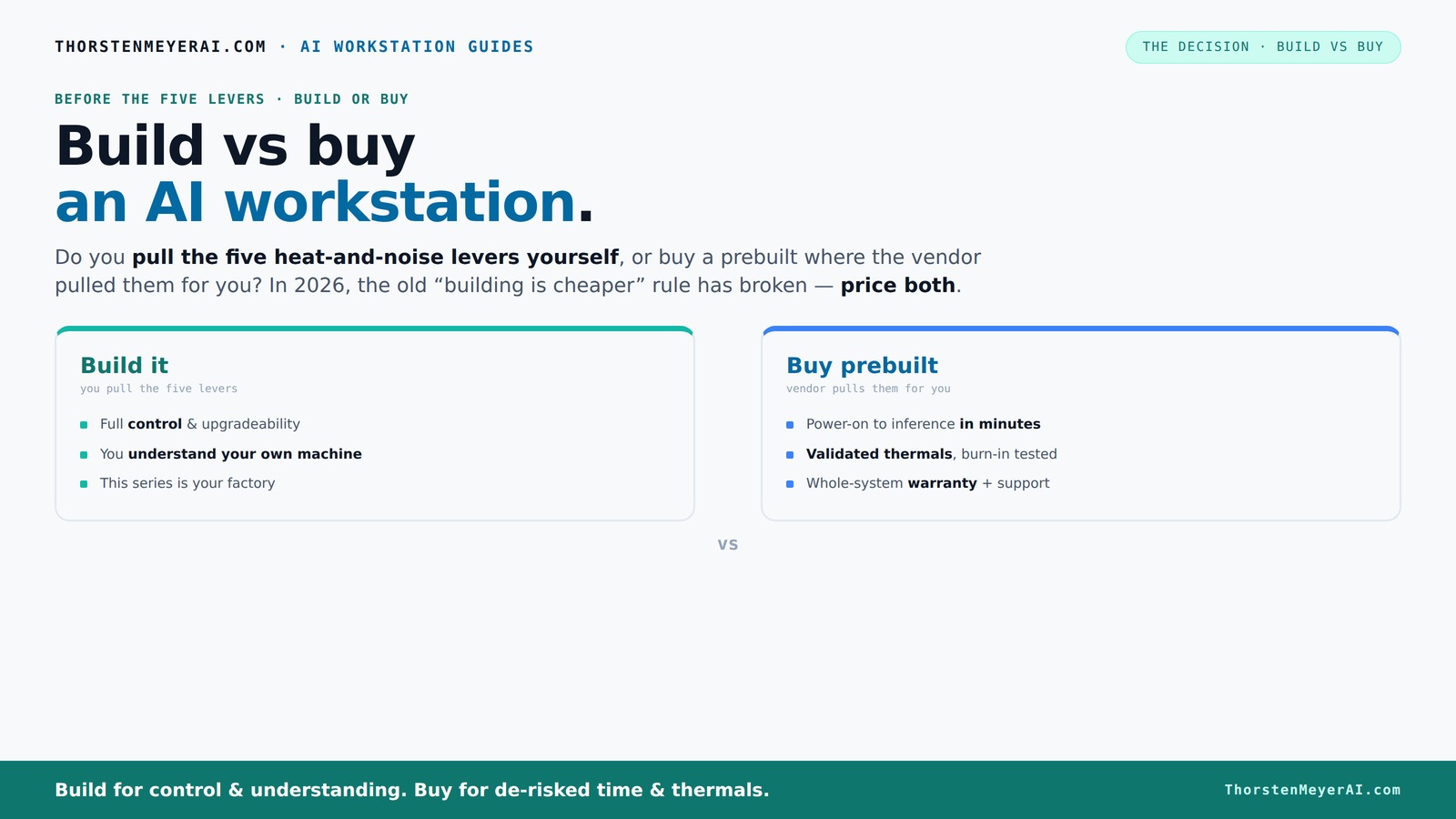
Build vs buy
an AI workstation.
The real question behind this whole series: do you pull the five heat-and-noise levers yourself, or buy a prebuilt where the vendor pulled them for you? And in 2026, the old “building is cheaper” rule has broken. Match your situation in Part 3.
Key Takeaways
- In 2026, component shortages and bulk buying have made prebuilt AI workstations often comparable in price to DIY builds, challenging the old rule that building always saves money.
- Thermal management and noise control are major factors; prebuilt systems are factory-tuned for silence and temperature, while DIY offers full control but requires expertise.
- Choosing between build and buy depends on your technical skills, time, need for support, and workload demands—there’s no one-size-fits-all answer.
- Always compare prices for your specific configuration today — market conditions fluctuate rapidly, especially in high-demand tech like AI hardware.
- Support and warranties are often overlooked but can save headaches during critical training runs; prebuilt vendors typically offer more comprehensive coverage. For more on this, visit chemicalceo.com.
As an affiliate, we earn on qualifying purchases.
Why Building Might Still Save You Money — But Only Sometimes
Building your own AI workstation used to be a no-brainer for saving cash. For insights on whether to build or buy a prebuilt AI workstation, check out this guide. You picked each part, shopped for deals, assembled, and kept costs low. But in 2026, the game has changed.
Component shortages and bulk buying mean high-end GPUs like the RTX 4090 or A100 now cost $1,500-$2,000 each—more than last year. If you’re considering your options, you might find this comparison of build vs buy AI workstations helpful. RAM and SSD prices are also up. A build that used to cost around $2,000 now easily hits $3,000 or more.
However, the real significance of this shift lies in understanding why these costs matter. When component prices spike, DIY builds become less of a bargain, forcing enthusiasts and professionals to evaluate whether their time and effort are justified. If you have the skills and patience, you might still find ways to optimize costs, but for most, the financial gap narrows or even reverses. Additionally, the tradeoff involves risk—buying expensive components without proper knowledge can lead to compatibility issues or suboptimal performance. Conversely, prebuilt systems leverage bulk purchasing and supply agreements to offer competitive or even better prices, which can be more cost-effective when factoring in your time and potential troubleshooting.
Meanwhile, big vendors like Dell, HP, and boutique builders buy in bulk, locking in prices before the shortages hit. They can offer a system with a premium GPU, cooling, and warranty at a price very close to or even below what you'd pay for DIY parts.
So, if your goal is to save money, don’t assume DIY always wins. Instead, compare costs for your exact specs now—sometimes, prebuilt wins on price, especially for high-end setups—and consider the hidden costs of time, troubleshooting, and potential hardware failures.
As an affiliate, we earn on qualifying purchases.
The Heat and Noise Challenge: Who Fixes It Better?
Cooling and noise are the invisible villains in high-power AI rigs. A machine running at full throttle can sound like a jet taking off, with heat radiating off the case. When you build, you control every lever—fans, airflow, cooling loops.
In 2026, prebuilt vendors have stepped up, offering systems that are extensively tested and tuned for thermal performance. Learn more about prebuilt AI systems and their advantages. They run extensive thermal testing, tune fan curves, and often include water cooling that’s whisper-quiet. BIZON, Lambda, and others validate their systems for hours, ensuring no throttling or overheating.
Building your own means you get to pick a quiet GPU, match the case airflow, and tune fans yourself. But it’s a skill that takes time and patience.
The core consideration here is how thermal management impacts your workload and environment. Overheating can throttle performance, reducing efficiency and increasing energy costs, while excessive noise can be distracting or even harmful over long periods. Prebuilt systems undergo rigorous testing to optimize these factors, often delivering a balanced, quiet operation out of the box. DIY setups, while flexible, require a deep understanding of airflow dynamics and cooling solutions to achieve comparable results. If you value a quiet, stable environment for intensive AI training, investing in a prebuilt that’s factory-tuned might save you time and frustration. Conversely, if you enjoy tinkering and have the expertise, customizing your cooling setup can yield excellent thermal performance, but it’s a tradeoff that demands time and knowledge.
The real question: do you want to spend hours tweaking or pay a premium for a system that’s tested, tuned, and supported? The answer depends on your comfort with thermal engineering and noise management.
As an affiliate, we earn on qualifying purchases.
Performance Customization: Build It Your Way or Pick a Ready-Made Rocket?
Performance isn’t just about slapping in a GPU. It’s about tuning the whole system—power delivery, cooling, BIOS settings—to squeeze every ounce of speed. Building allows full customization: choose your CPU, GPU, RAM, and even the case airflow to match your workload.
Prebuilts are becoming more flexible, with options for multi-GPU setups or specialized cooling. Vendors test their systems under real workloads, so you get a machine that’s balanced and validated.
For example, Lambda’s systems are designed specifically for multi-GPU AI training, with robust power supplies and water cooling. That’s hard to DIY without serious expertise.
If your workload demands peak performance and fine-tuning, building gives you control. But if you prefer a proven, balanced setup, prebuilt systems do the heavy lifting for you. The key implication is that performance tuning isn’t just about hardware specs but also about system integration. A well-tuned prebuilt can outperform a DIY setup if the latter isn’t optimized. Conversely, for those willing to invest time, building offers the opportunity to customize every aspect, potentially squeezing out extra performance tailored precisely to your needs. The tradeoff is complexity—building requires understanding of hardware compatibility, BIOS tuning, and thermal management—whereas prebuilt systems come pre-optimized, saving time but offering less flexibility for radical customization.
As an affiliate, we earn on qualifying purchases.
Support, Warranties, and Peace of Mind
When your AI training runs on the line, support matters. Building your own means hunting down individual warranties—GPU, RAM, motherboard—and troubleshooting issues yourself or through multiple vendors. This fragmented approach can lead to delays, especially if hardware incompatibilities or failures occur during critical periods.
Prebuilt vendors bundle support, offer warranties up to 5 years, and test systems thoroughly before shipping. If something breaks during a training marathon, they’re on the hook. That peace of mind can be worth the extra cost, especially for critical projects where downtime isn’t an option. Additionally, comprehensive support reduces the cognitive load—knowing you have a single point of contact for troubleshooting can significantly decrease stress and downtime.
For instance, Puget Systems runs each system under load for 24–48 hours before delivery, catching problems early. Plus, you get expert support on the phone, which can be invaluable when dealing with complex hardware or software issues. This level of support often includes proactive diagnostics, firmware updates, and troubleshooting, which can extend your system’s lifespan and reliability.
The main implication here is that support and warranties are investments in reliability. If your projects are mission-critical or if you lack the time or expertise to troubleshoot hardware issues, prebuilt support can be a decisive factor in your decision-making process.
Making Your Decision: When to Build, When to Buy
Here’s a quick decision checklist:
- Build: You love tinkering, have time, want full control, and enjoy learning about hardware.
- Buy: You prioritize plug-and-play, support, and peace of mind, and your time is valuable.
- Cost considerations: Today, compare prices for your exact specs—sometimes prebuilt is cheaper, especially with shortages.
- Performance: If you need a highly optimized, multi-GPU system, vendors are already there.
- Support: If avoiding headaches is your priority, prebuilt wins.
Remember: recent market shifts mean you should always price both options before deciding. The old rule—build cheaper, buy faster—no longer holds universally.
Comparison Table: Build vs Buy in 2026
| Aspect | Build Your Own | Prebuilt System |
|---|---|---|
| Cost | Variable, often cheaper if you find deals; can be $2,000–$3,500 for high-end | Often similar or less due to bulk discounts; starts at $2,500 and up |
| Time & Effort | Hours to days of assembly, troubleshooting, tuning | Minutes to plug in, install OS, start working |
| Performance Tuning | Full control; requires expertise | Validated by vendor; tuned for balance and thermals |
| Support & Warranty | Depends on components; multiple warranties | Bundled support; up to 5-year warranty |
| Upgradability | Easy to upgrade components over time | Varies; some models more flexible than others |
| Thermal & Noise Management | Your responsibility; can be optimized | Factory tested; often quieter & cooler |
Frequently Asked Questions
Is it cheaper to build my own AI workstation or buy a prebuilt?
It varies. Due to current component shortages and bulk discounts, prebuilt systems often match or beat DIY costs for high-end configurations. Always compare prices for your specific specs before deciding.What are the best components for a DIY AI workstation?
Look for a high-end GPU like the NVIDIA RTX 4090 or A100, at least 64GB of RAM, fast NVMe SSDs, and a reliable CPU such as an AMD Ryzen or Intel Xeon. Check compatibility and cooling solutions carefully.How difficult is it to build an AI workstation?
Moderate to challenging, especially if you’re new. It involves hardware assembly, BIOS configuration, driver setup, and software tuning. Patience and research are key.Can I upgrade a prebuilt AI workstation later?
Often yes, but it depends on the chassis and motherboard design. Some are more modular than others, so check before buying if future upgrades matter to you.What should I consider when choosing between build and buy?
Your budget, technical expertise, time constraints, workload demands, and support needs. Remember, recent market shifts mean you should compare prices for your exact specs now.Conclusion
Deciding whether to build or buy your AI workstation isn’t just about dollars. It’s about control versus convenience, expertise versus support. In 2026, the best choice depends on your unique needs and how much you value peace of mind.
Remember: with prices and supply chains shifting, always price both options now—what seemed cheaper last year might not be today. The right machine is the one that fits your workload, skills, and schedule, not just your budget.
Fall Picks
fall essentials
As an affiliate, we earn on qualifying purchases.

![Paxos Made Simple (2001) [Pdf]](https://whatifmonsters.com/wp-content/uploads/2026/07/paxos-made-simple-2001-pdf-featured-560x300.jpg)